
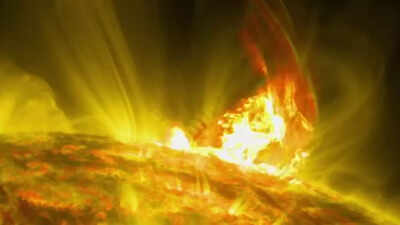
For centuries, the sun has been one of the most recognized but least understood phenomena in the sky. We have always seen it as a ball of light shining in the sky, but the reality is much rougher and more complex. Behind its calm façade lies a world constantly changing with high temperatures, powerful magnetic fields, and explosive releases of energy. Until recently, many of these phenomena have been confined simply because the Sun is too bright to observe up close.However, scientists were recently able to overcome this problem with an amazing space experiment. By creating an artificial solar eclipse in space, scientists were able to capture footage of a never-before-seen phenomenon: giant plasma ejecting from the sun’s atmosphere. While these photos are certainly awe-inspiring, they also provide important clues to unlocking the secrets of the sun and its movement in space.
how scientists fake solar eclipse Going to space to study the sun’s corona
To tackle this challenge, researchers turned to space technology. The European Space Agency’s Proba-3 mission uses two satellites in perfect formation, with a distance of about 150 meters between them. In this setup, one satellite simulates the moon and obscures, or hides, the bright center of the sun. This satellite is called Occulter. The other satellite is named Coronagraph. It lies precisely in the shadow of the occulter. It is protected from the sun’s bright light, allowing it to photograph the corona in great detail. This precise positioning requires the highest precision, with the two satellites flying at high speed around the Earth while maintaining their position within millimeters.
In September 2025, the Proba-3 mission achieved a continuous artificial solar eclipse lasting almost 5 hours. During this time, the coronagraph was able to take a photo of the Sun every five minutes and capture time-lapse video of the Sun’s outer atmosphere as it moved.To provide a complete understanding, researchers were able to overlay the images with data from NASA’s Solar Dynamics Observatory, which observes the sun’s surface. This allowed the researchers to observe the sun’s surface and corona simultaneously, demonstrating how activity on the surface is directly related to events occurring in the corona. As part of this observation, three giant plasma structures were observed rising and peeling off from the Sun.
Why is the sun’s corona so hot that it is difficult to observe?
The corona is the outermost part of the sun’s atmosphere. It extends millions of kilometers into space. One of the most interesting things about the corona is that even though it is far away from the Sun’s core, it is actually hotter than the layers of the Sun below. The sun’s surface temperature is 5,500 degrees Celsius, but the temperature in the corona can actually reach more than 1 million degrees Celsius.The most difficult thing about seeing the corona is its brightness. In fact, the sun’s surface is brighter than all other telescopes, so the corona is barely visible. The only time the corona can be observed from Earth is during a total solar eclipse, when the moon passes in front of the center of the sun for several minutes.
what solar prominence That’s really true
The huge buildings you see are called solar prominences. They are giant clouds of ionized gas suspended in the Sun’s atmosphere by magnetic fields. Although they appear solid, they are composed of superheated particles that follow completely invisible magnetic field lines.Although the prominence’s temperature is lower than its surroundings, about 10,000 degrees Celsius, it is still much hotter than anything found on Earth. When magnetic forces become unstable, they can suddenly grow and spew energy and matter into space.