
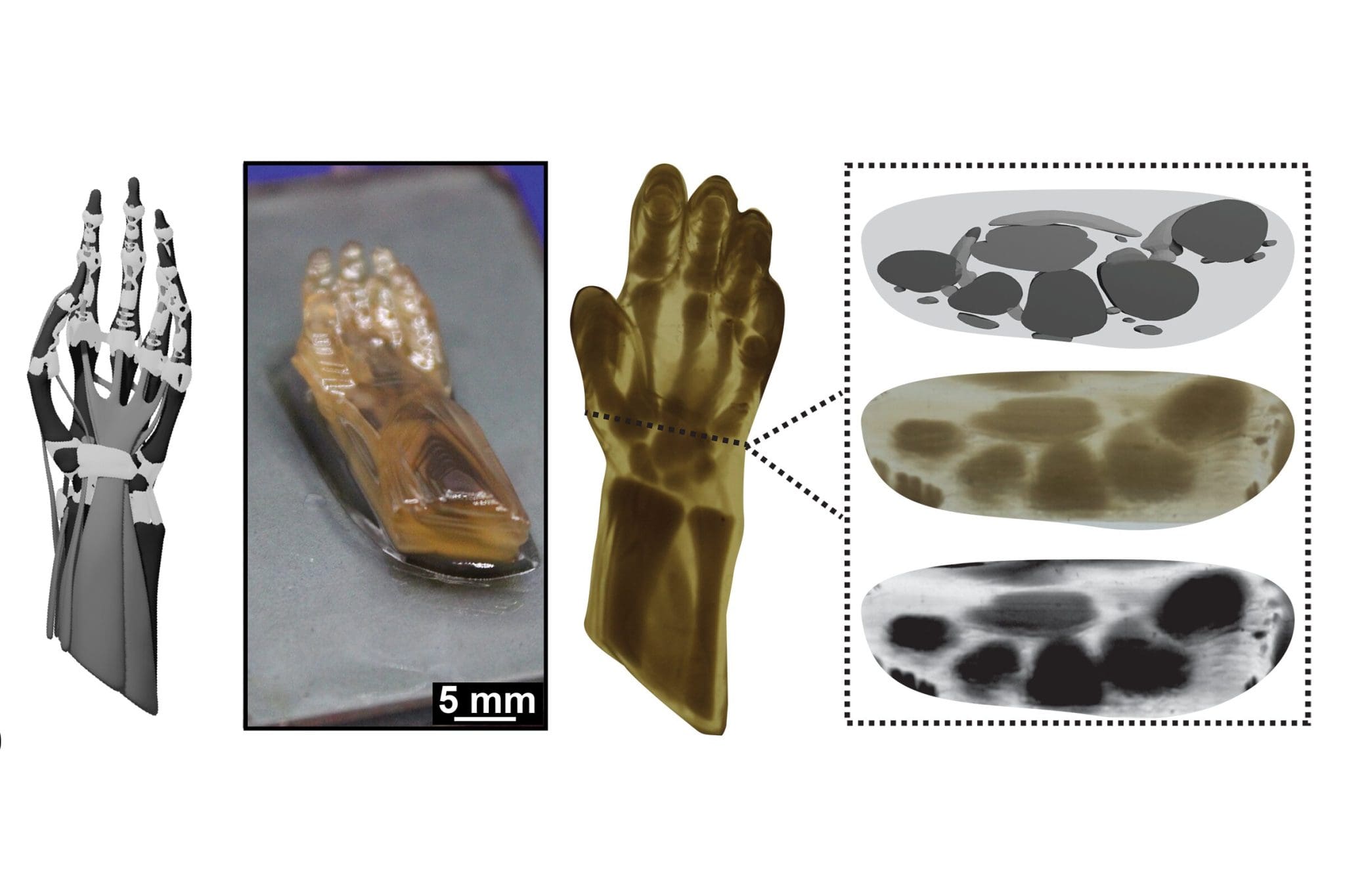
Researchers at the University of Texas at Austin have developed CRAFT, a 3D printing method that uses inexpensive hardware to create complex replicas of human hands from a single material, improving medical training and protective equipment.
developed by researchers New 3D printing technology allows you to create objects with extremely diverse physical properties pixel by pixel. Using an inexpensive commercially available printer and a single raw material, the research team was able to create a realistic model of the human hand that mimics the unique mechanical properties of skin, ligaments, tendons, and bones.
The method, titled Controlled Crystallinity in Additive Manufacturing of Thermoplastics (CRAFT), was detailed in the journal Science by a joint team from several national laboratories, including the University of Texas at Austin and Sandia National Laboratories.
Complexity of optical engineering
The CRAFT method utilizes a standard digital light processing (DLP) printer to convert a liquid resin called cyclooctene into a solid plastic. Unlike conventional 3D printing, Achieving different textures often requires different “inks,” and CRAFT achieves complexity by varying the intensity of light projected onto the resin.
By controlling molecular order in three dimensions, researchers can modify the mechanical and optical properties of materials during the printing process. High-intensity light can produce hard bone-like structures, while low-intensity light produces flexible, rubbery areas. Because the entire object is printed from a single material, it avoids “interface failures” commonly seen in multi-material prints, where different materials fail to bond and separate under stress.
Applications of 3D printing in healthcare and safety
One of the main uses of this technology is the creation of high-fidelity medical training models. Traditional 3D printed models often lack the subtle “feel” of human tissue, forcing medical schools to rely on expensive and difficult-to-obtain cadavers. CRAFT allows you to create models that simulate the interconnected nature of human anatomy, such as the knee joint with its moving ligaments and hard bones.
Beyond medicine, researchers envision using CRAFT in “biologically inspired materials” for personal protective equipment. By mimicking structures found in nature, such as tree bark and bone, this method allows helmets and armor to be created with alternating hard and soft zones designed to more effectively absorb vibrations and shock.
accessibility and sustainability
A major advantage of the CRAFT method is its cost-effectiveness. While many high-end multi-material printers cost tens of thousands of dollars, CRAFT is compatible with consumer-grade resin printers that cost less than $1,000.
Additionally, this method offers a potential path toward reducing manufacturing waste. Objects created using this process can be melted or dissolved in a solvent, allowing the material to be reshaped into new shapes.