
Earth is often described as a world of water, but we still don’t know how that water got there. For many years, the focus has been on asteroids and comets that carry hydrogen long after the planets have formed. A recently studied meteorite seeks to overturn that idea. The rock is rare and chemically unusual, providing evidence that hydrogen may have been present all along. It doesn’t completely overturn decades of research, but it complicates a neat story. The discovery came from detailed laboratory analysis rather than dramatic new samples or space missions. They point to small chemical signals that have been overlooked until now. Taken together, these suggest that before the existence of oceans, Earth’s components may already have been quietly transporting water’s needs, and in sufficient quantities.
Rare meteorite casts doubt on long-held theories about Earth’s water
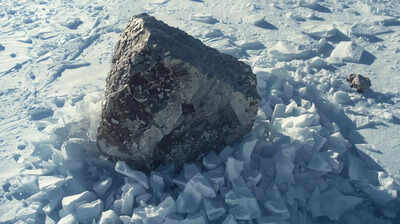
The meteorite at the center of the study belongs to a group known as enstatite chondrites. These rocks are thought to best match the material that built the early Earth about 4.5 billion years ago. They are usually described as dry, meaning that the minerals appear to contain little or no water. This assumption has shaped models of planet formation for decades. The sample analyzed in this study, known as LAR 12252, was recovered from Antarctica but is chemically consistent with enstatite chondrites found elsewhere. Its value lies in its antiquity and resistance to later alterations. For researchers trying to trace Earth’s origins, it’s a rare, quiet record.
Hydrogen hidden in places scientists don’t see
researchers oxford university The meteorite was examined using X-ray absorption technology at the Diamond Light Source in Oxfordshire. Previous research had found small traces of hydrogen in organic matter in rocks, but much of it remained unknown. The University of Oxford team took a different approach. They thought that hydrogen might be bonded to sulfur rather than oxygen. When they looked closely at the microscopic matrix material between the chondrules, they discovered high concentrations of hydrogen sulfide. In some areas, the hydrogen content was several times higher than in previously investigated areas. The distribution was uneven, subtle, and easy to miss without targeted analysis.
Evidence to eliminate global pollution
One of the main challenges in meteorite research is separating the original signal from contamination after it lands on Earth. The researchers compared areas rich in hydrogen with areas showing signs of rust and cracking. These damaged areas contained little or no hydrogen. This contrast was important. Therefore, it is unlikely that hydrogen sulfide was generated by exposure to air or water on Earth. Instead, it appeared to be trapped within the meteorite’s structure. Hydrogen combined with sulfur in minerals such as pyrrhotite, which forms under high temperature conditions. This detail helped anchor the discovery in early solar system processes rather than later interference.
Rethinking how water forms naturally
If enstatite chondrites hold more hydrogen than previously thought, the implications would be far-reaching. The Earth was formed primarily from this type of material. This means that hydrogen may have been present in Earth’s early stages, embedded within its constituent elements. As the planet heated and differentiated, its hydrogen could have combined with oxygen to form water. This does not preclude later delivery by asteroid, but it reduces the need for it. Water may be a natural result of the Earth’s composition, rather than a lucky addition. This idea shifts the emphasis from rare collisions to more common chemistry.
What this means for planetary science
The discovery adds weight to the growing view that Earth’s habitability was no accident. Similar processes may occur in other rocky planets that form near stars. Hydrogen bonded to sulfur is not easily detected and may be present in other meteorites that have already been studied. The study also reveals how assumptions about desiccation can persist simply because certain forms of hydrogen are difficult to measure. As technology improves, new details may emerge from older samples. So far, the meteorite has not provided a final answer. That led scientists to a quiet conclusion: Earth may have been carrying ocean species from the beginning, waiting for the right conditions for them to surface.