
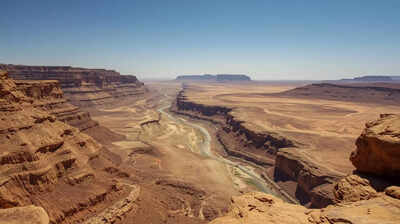
The rock faces of some of southern Africa’s driest regions hold silent records of a world long ago. Marble and limestone formations formed long before today’s deserts formed, and often preserve signs of climate change and gradual geological stress. Most traces fit into known patterns of erosion or mineral alteration. But in outcrops scattered across Namibia and parts of the Arabian Peninsula, researchers have noticed something unsettling about these explanations. Fine repeating tunnels run through the stone in tight parallel lines. They follow the crack, but extend beyond it and cut into the solid rock. The shape is controlled and the spacing is constant. These features seem old, inactive, and difficult to explain. These refer to processes that currently do not run in these environments.
Evidence of ancient microbial activity found in Namibia desert rock formation
This structure has been found in the desert regions of Namibia, Oman, and Saudi Arabia. In Namibia, it is found in Neoproterozoic marble exposed along river valleys and plateaus far from the coast. Similar features occur in limestone formations throughout the Arabian Peninsula. The common feature is geological stability. These rocks have not undergone significant deformation for hundreds of millions of years.Tunnels appear as bands rather than isolated holes. Each band can be several meters long, and sometimes breaks and then reverts back to intact stone. Individual tunnels are small, less than a millimeter wide and only a few centimeters long. They are always aligned. They don’t randomly intersect or branch. This regularity is one of the details that has attracted attention in this field.
Erosion alone is not enough
At first glance, weathering seems like an obvious explanation. Desert rocks often exhibit pitting, spalling, and chemical alteration. However, these tunnels behave differently. They traverse the mineral layers without disturbing them. Frequently, stripes of the original color of the marble remain along the tunnel walls, suggesting that the material was removed rather than replaced.Typical karst processes result in irregular cavities and widening cracks. Crystallization leaves an angular pattern. Stresses in the earth’s crust create cracks, but not parallel thin tubes. None of these processes produce closely packed, evenly spaced borings that stop at similar depths. The geometry appears to be controlled rather than accidental.
Signs of biological activity
paper researcher “Endolithic microholes associated with subfossil destruction in marble and limestone” We conducted a detailed analysis that gave weight to biological explanations. Tunnels are often filled with fine white calcite that contrasts with the host rock. Chemical tests show that this filling is deficient in several elements compared to the surrounding stone. Researchers detected a thin rim rich in phosphorus and sulfur along the edge of the tunnel.Microscopy and spectroscopy reveal traces of degraded biological material. Carbon isotope values also fall within ranges relevant to life. DNA and proteins no longer exist, which is not surprising given the age. But chemical fingerprints remain. Taken together, these suggest that the microbes burrowed into rocks during their lives and left behind altered mineral chemistry when conditions changed.
what kind of organism can do this
Endolithic microorganisms are known to live inside rocks in extreme environments. Some occupy the cracks. Some actively dissolve minerals to create space. These creatures are found in places where surface conditions are harsh but the interiors of rocks are protected, such as Antarctica and the Atacama Desert.The newly described tunnels are similar to endolithism, where microorganisms drill holes directly into carbonate rocks. What is unusual is its size and organization. The tunnels form long bands with consistent orientation, suggesting a common growth direction or environmental trigger. No known modern organisms produce exactly this pattern. It remains unclear whether the causative microorganism still exists or is extinct.
The desert hides an unexpected history
Currently, the areas where these tunnels exist are extremely dry. It rarely rains. Biological activity is restricted. However, this tunnel hints at conditions in which microbial life was once possible within the rock. It doesn’t require a lush landscape, but it does require a different balance of moisture and chemicals.Because deserts preserve surfaces largely undisturbed, they can trap evidence that would otherwise be erased. Features formed deep within a rock mass can later be exposed through erosion and look almost out of place in modern climates.
This is important for the planet and beyond
Carbonate rocks contain most of the earth’s carbon. Understanding how life interacts with them is important for models of the global carbon cycle. Even small biological effects, when repeated over large areas and over long periods of time, can transfer carbon between solid rocks and the environment.These discoveries are also important beyond Earth. Similar carbonate rocks exist on Mars. If microbes once lived inside them, their traces may seem subtle and unfamiliar. The tunnels in Namibia and Arabia show that life forms can leave traces that are not fossil-like in the usual sense.The band ends with a quiet break. There is no clear beginning or end. Just leaving a mark, cutting into the stone, waiting to be noticed.