
Images: NASA, ESA, VLA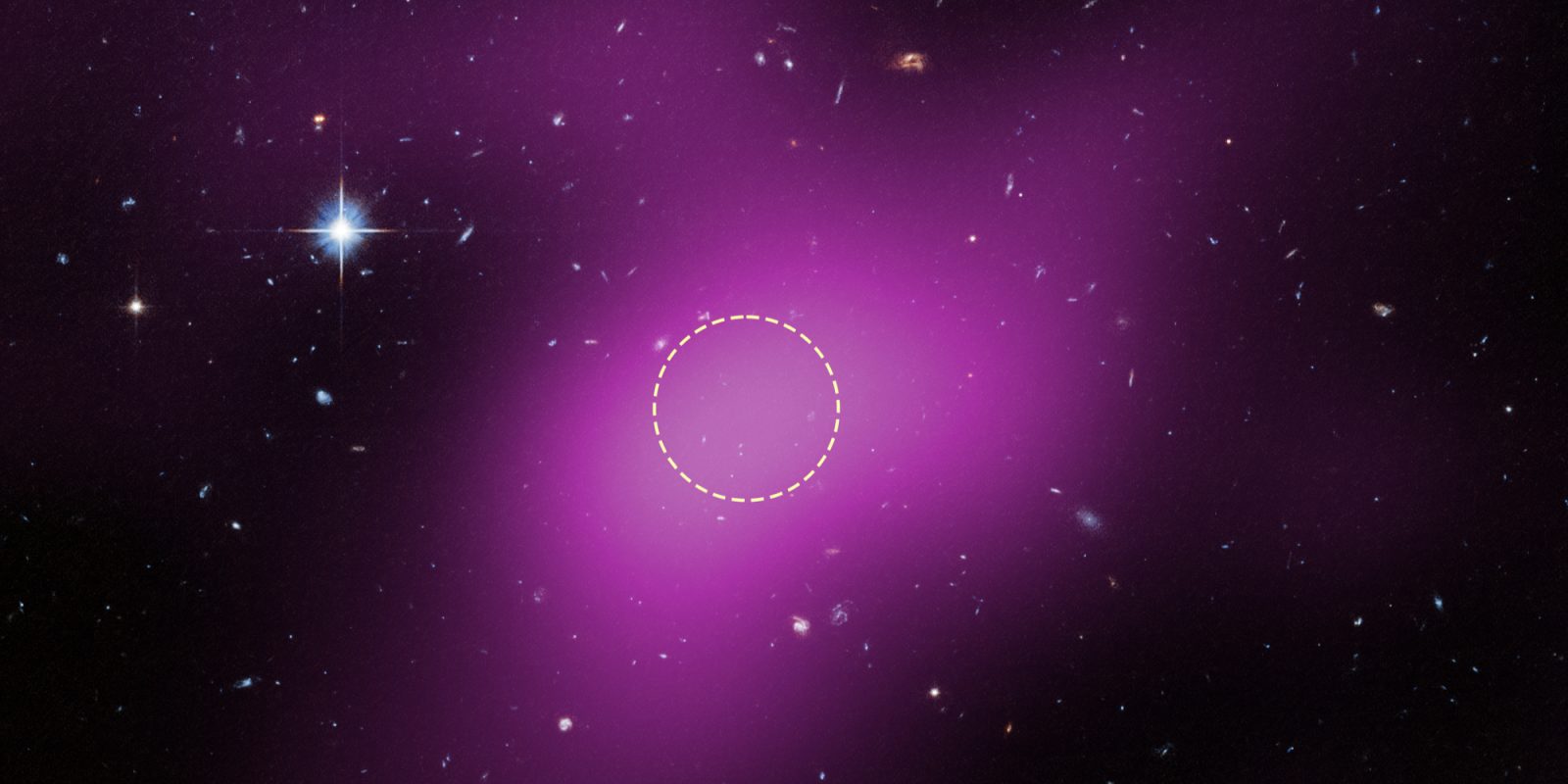
When astronomers talk about the “dark universe,” they are usually referring to what we can’t see directly: dark matter, which makes up most of the mass of the universe, and the early stages of galaxy formation. Currently, astronomers at NASA hubble space telescope They have helped confirm the existence of rare celestial objects that link both ideas. It is a starless, gas-rich structure dominated by dark matter, known as Cloud 9.
Cloud-9 is located 14 million light-years from Earth. Unlike typical galaxies, this galaxy is not glowing. Although it contains a compact reservoir of neutral hydrogen gas, it shows no evidence of star formation, making it the first confirmed example of an object long predicted by cosmological models but never definitively observed. According to NASACloud-9 appears to be a relic from the early universe, a structure where gas and dark matter accumulated but no stars ignited.
This discovery began with radio astronomy rather than optical imaging. Neutral hydrogen naturally emits radiation at a wavelength of 21 centimeters, allowing radio telescopes to detect gas clouds that are otherwise invisible. Cloud-9 was first identified using China’s 500-meter Spherical Telescope, followed by follow-up observations from facilities such as the Green Bank Telescope in West Virginia and the Very Large Array in New Mexico. These observations revealed dense concentrations with motion suggesting that the hydrogen gas is bound by gravity.
But radio data alone couldn’t answer the key question: Is Cloud-9 hiding a very faint dwarf galaxy? Using Hubble, astronomers were able to see better.
Using detailed observations from Advanced Camera for Surveys equipment, Hubble photographed this area Surround Cloud-9 with high resolution and sensitive optical wavelengths. Instead of detecting even a sparse number of stars, Hubble didn’t find anything related to clouds.
The objects visible within the target region matched distant background galaxies rather than stars bound to Cloud-9. NASA said this lack of starlight allows astronomers to classify Cloud-9 as a truly starless structure.
As a result, Cloud-9 has been elevated from a mere observational curiosity to an object of scientific value. This fits into a theoretical category known as . Reionization limited HI cloudor RELHIC – a halo of dark matter that held gas after the cosmic reionization epoch but never became dense enough to form stars. Although these objects are considered common in simulations, they are very difficult to observe.
Cloud-9’s estimated gas mass is about 1 million times that of the Sun, but its dark matter halo could be thousands of times more massive. Lacking stars to complicate its environment, the object provides a uniquely clean laboratory to study how dark matter behaves and how early cosmic structures make or fail to become galaxies.
The discovery came during a period of rapid discoveries in astronomy. NASA’s james webb space telescope discovers an unexpectedly mature galaxy in the early Universe and reconstructs the timeline of star formation. Cloud-9 complements these discoveries by revealing the opposite result: what would happen if the universe gathered mass but did not produce light.
Even in the era of the James Webb Space Telescope, Hubble remains essential for probing nearby, faint structures that emit little light, where high-resolution optical imaging is important. Discoveries like Cloud-9 show that Hubble continues to test core theories of galaxy formation and dark matter decades after its launch.


FTC: We use automated affiliate links that generate income. more.