
How do nature and nurture shape our immune cells?
- highlights
- Researchers at the Salk Institute analyzed immune cells from 110 people and found that genetic differences and life experiences (diseases, vaccination history, environment) affect immune cells differently.
- The findings help explain why people respond differently to the same infection and treatment.
- This research provides the foundation for personalized medicine to prevent the onset of disease, strengthen immune health, and treat infectious diseases, cancer, and other immune diseases.
LA JOLLA — The COVID-19 pandemic has given us a greater perspective on how symptoms and outcomes can vary widely between patients experiencing the same infection. How can two people infected with the same pathogen react so differently?

click hereFor high resolution images.
Credit: Salk Institute
It largely comes down to diversity in genetics (genes you inherit) and life experiences (environment, infections, vaccination history). These two influences are imprinted on cells through small molecular changes called epigenetic changes, which shape cell identity and function by controlling whether genes are turned “on” or “off.”
Salk Institute researchers present a new epigenetic catalog that reveals the distinct effects of genetic inheritance and life experiences on different types of immune cells. The new cell type-specific database natural genetics The paper, published on January 27, 2026, helps explain individual differences in immune responses and could be the basis for more effective and personalized treatments.
“Our immune cells hold molecular records of both our genes and our life experiences, and these two forces shape our immune systems in very different ways,” said the senior author. Dr. Joseph Ecker, Professor, Chair of the Salk International Council on Genetics, Howard Hughes Medical Institute Investigator. “This study shows that infections and environmental exposures leave lasting epigenetic imprints that influence the behavior of immune cells. Resolving these effects on a cell-by-cell basis allows us to link genetic and epigenetic risk factors to the specific immune cells where disease actually begins.”
What is the epigenome?
All cells in the body share the same DNA sequence. Still, there are many specialized cell types that look and behave very differently. Part of this diversity is due to a collection of small molecular tags called epigenetic markers. Epigenetic markers decorate DNA and signal which genes to turn on or off in each cell. The many epigenetic changes in each cell collectively constitute that cell’s changes. epigenome.
Unlike the basic genetic code, the epigenome is much more flexible. Some epigenetic differences are strongly influenced by genetic variation, while others are acquired empirically throughout life. Immune cells are no exception to these forces, but it was unclear whether these two types of epigenetic changes (genetic and experiential) affect immune cells in the same way.
“The debate between nature and nurture is a long-standing debate in both biology and society,” says co-first author Wenliang Wang, Ph.D., a staff scientist in the Ecker lab. “Ultimately, both genetic inheritance and environmental factors influence us. We wanted to figure out exactly how that manifests itself in immune cells and affects our health.”
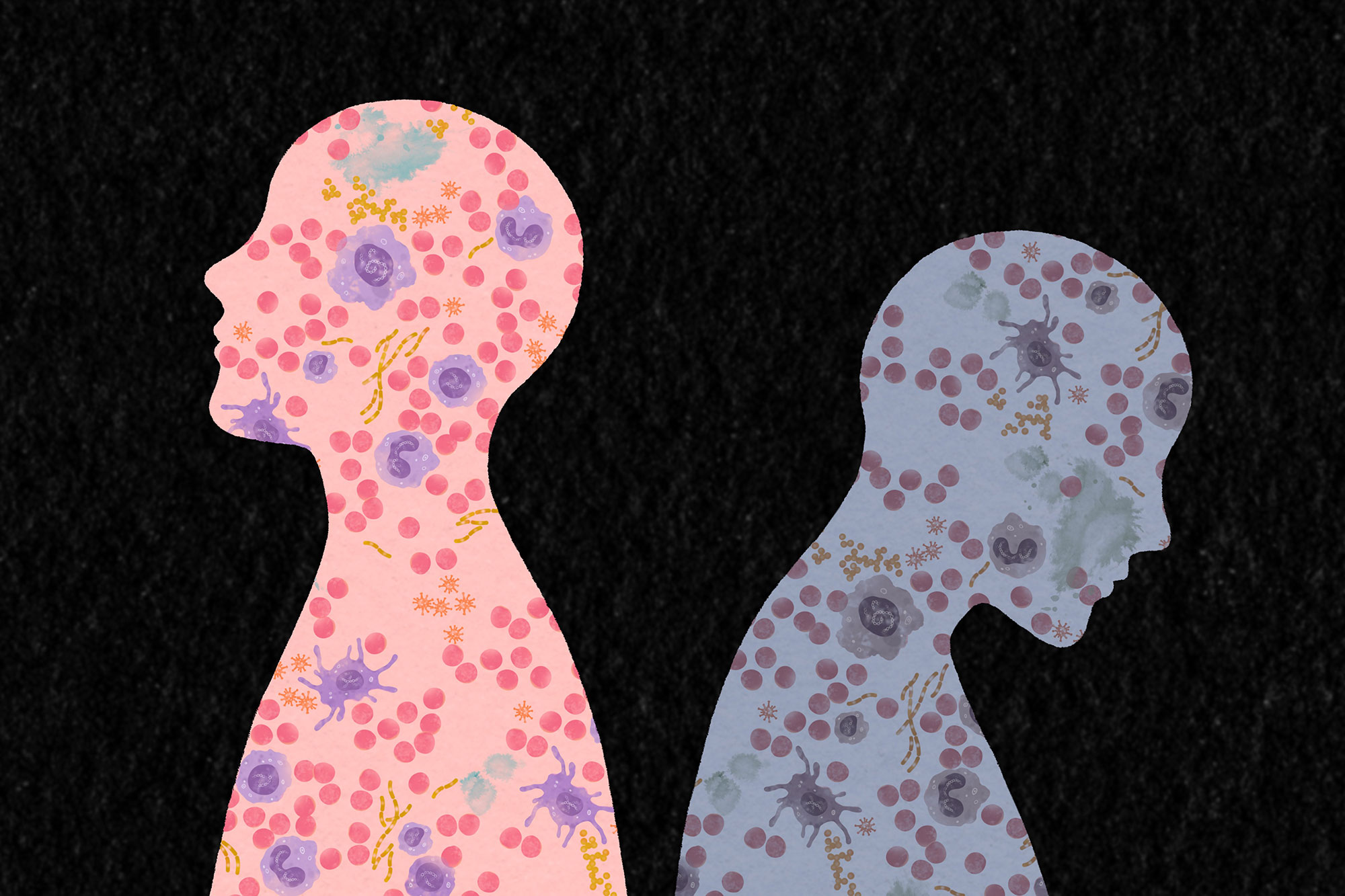
click here For high resolution images.
Credit: Salk Institute
How do your life experiences affect your immune cells?
To determine how nature and nurture influence the epigenome of immune cells, Salk’s team needed to examine a diverse pool of samples. By collecting and analyzing blood samples from 110 people, researchers were able to observe the effects of different genetic profiles and life experiences. HIV-1, MRSA, MSSA, SARS-CoV-2 infections. Anthrax vaccination. Exposure to organophosphate pesticides.
The researchers then compared the epigenetic profiles of four major immune cell types. One is T cells and B cells, which are known for their long-term memory of past infections, and the other is monocytes and natural killer cells, which respond more broadly and quickly. From these many samples and cells, the team built a catalog of all epigenetic markers. Differentially methylated regions (DMR), in each cell type.
“We found that genetic mutations associated with disease often function by altering DNA methylation in specific immune cell types,” says co-author Dr. Woobin Ding, a postdoctoral fellow in Ecker’s lab. “Mapping these relationships allows us to pinpoint which cells and molecular pathways are affected by disease risk genes, potentially opening new avenues for more targeted treatments.”
Importantly, the researchers were able to analyze which epigenetic changes are genetically inherited (gDMR) and which are due to life experiences (eDMR). It has been shown that gDMRs and eDMRs are concentrated in different regions of the epigenome, with gDMRs located in more stable gene regions, especially around long-lived T and B cells, and eDMRs mainly located in flexible regulatory regions that trigger specific immune responses.
Based on variations in the location of gDMRs and eDMRs, the data suggest that genetic inheritance shapes a more stable long-term immune program, whereas life experiences preferentially influence dynamic, context-specific immune responses. Further research will be required to elucidate the precise impact of natural and nurture factors on immune performance.
“Our Human Population Immune Cell Atlas will also be a great resource for future mechanistic studies of both infectious and genetic diseases, including diagnosis and prognosis,” said co-first author Manoj Hariharan, Ph.D., a senior staff scientist in the Ecker lab. “Often when people get sick, the cause or potential severity is not immediately clear. The epigenetic signatures we have developed provide a roadmap for classifying and evaluating these situations.”
Can we use the epigenome of immune cells to predict patient outcomes?
This finding demonstrates the unique and substantial influence of both nature and nurture on immune cell identity and immune system performance. Additionally, this catalog provides an exciting starting point for creating a new personalized treatment plan.
Ecker explains that with more time and more patient samples, this catalog could serve as a blueprint for predicting how someone will respond to an infection. For example, if enough COVID-19 patients contribute their immune cells to a database, researchers could discover that all survivors share the same eDMR. From there, scientists can profile new COVID-19 patients to see if they already have this protective eDMR, and if not, identify the protective control mechanisms associated with it and target them with treatments.
“Our research lays the foundation for developing precise prevention strategies against infectious diseases,” Wang said. “For COVID-19, influenza, and many other infectious diseases, as cohorts and models continue to expand, we may one day be able to predict how someone will respond to an infection, even before they are exposed to the infection. Instead, we can use the genome to predict how an infection will affect the epigenome, and then predict how those epigenetic changes will affect symptoms.”
Other authors and funding
Other authors include Anna Bartlett, Cesar Barragan, Rosa Castanon, Vince Rothenberg, Haili Song, Joseph Nelly, Jordan Altschul, Mia Kenworthy, Han-Qing Liu, Wei Tian, Jingtian Zhou, Qiurui Zeng, and Salk’s Huaming Cheng. Andrew Aldridge, Lisa L. Satterwhite, Thomas W. Burke, Elizabeth A. Petzoldt, and Vance G. Fowler Jr. of Duke University; Bei Wei and William J. Greenleaf of Stanford University; Irem B. Gunduz and Fabian Müller from Saarland University. Todd Norrell and Timothy J. Broderick of the Florida Institute for Human and Machine Cognition; Micah T. McClain and Christopher W. Woods of Duke University and Durham Veterans Affairs Medical Center; Mr. Xiling Shen of Terasaki Pharmaceutical Innovation Research Institute. Parinya Panuwet and Dana B. Barr of Emory University; Jennifer L. Baer, Anthony K. Smith, and Rachel R. Sperbeck of Battelle Memorial Institute; Sindhu Vanghetti, Eileen Ramos, German Nudelman, and Stuart C. Sealfon of the Icahn School of Medicine at Mount Sinai; Flora Castelino of the U.S. Department of Health and Human Services; and Anna Maria Walley and Thomas Evans of Vaccitech plc.
This research was supported by the U.S. Army Research Office (W911NF-19-2-0185), the National Institutes of Health (P50-HG007735, UM1-HG009442, UM1-HG009436, 1R01AI165671), and the Defense Advanced Research Projects Agency (N6600119C4022) through the National Science Foundation. (1548562, 1540931, 2005632).
Doi: 10.1038/s41588-025-02479-6