
Anti-EGFR therapy has become a core component of first-line treatment for RAS/BRAFV600 wild-type metastatic tumors colorectal cancerEspecially in MSS/pMMR diseases. However, even within molecularly “competent” populations, results remain heterogeneous and reflect additional resistance mechanisms beyond canonical RAS/BRAF alterations.
Among these, alterations in the HER-2 (ERBB2) gene, including amplifications and point mutations, have emerged as biologically plausible factors for primary resistance to EGFR blockade. Although HER-2 amplification is established as a targetable change in CRC, its prognostic value and impact on anti-EGFR efficacy remain controversial, and the clinical relevance of HER-2 mutations is even less clear. In this context, the results of the exploratory biomarker analysis of the CAPRI-2 GOIM trial ESMO Gastrointestinal Oncology In 2026, we evaluated how changes in ERBB2 correlate with response and survival in patients treated with FOLFIRI + cetuximab in the first line.
title: HER-2 genetic alterations as a biomarker in metastatic colorectal cancer patients treated with FOLFIRI + cetuximab: results from the CAPRI-2 GOIM study
author: D. Ciardiello, L. Boscolo Biello, S. Napolitano, E. Martinelli, T. Troiani, E. Cioli, TP Latiano, E. Maiello, P. Parente, A. Abalone, A. De Stefano, R. Bordonaro, A.E. Russo, C. Rotesoliere, S. Vararelli, S. Pisconti, C. Nisi, E. Tamburini, MG Viola, S. Ronaldi, C. Cremolini, D. Iacono, P. Tagliaferri, F. Pietrantonio, G. Tortola, G. Rosati, MG Zampino, G. Crigliano, A. Febraro, N. Normanno, F. De Vita, N. Fazio, F. Ciardiello, G. Martini.
method
This was an exploratory biomarker analysis within the CAPRI-2 GOIM Phase II trial (NCT05312398). Patients with initially RAS/BRAFV600 wild-type, MSS/pMMR mCRC received FOLFIRI and cetuximab as first-line. Before treatment, plasma and tumor tissue were collected for comprehensive genomic profiling using FoundationOne CDx (tissue) and FoundationOne Liquid CDx (plasma).
HER-2 positivity was defined by ERBB2 amplification (gene copy number ≥4) or ERBB2 mutation detected in tissue and/or liquid biopsy. This analysis used the Kaplan-Meier method, log-rank test, and Cox proportional hazards modeling (exploratory to account for the small HER-2-positive cohort) to compare HER-2-positive and HER-2-negative tumors and examine objective response rate (ORR), progression-free survival (PFS; from treatment initiation to progression or death), and overall survival (OS).
result
Of the 240 patients screened, 192 received primary treatment and were eligible for evaluation. After exclusions (including tumors with RAS/BRAFV600 pathogenic variants and lack of significant clinical data), the final cohort included 161 HER-2-negative and 10 HER-2-positive RAS/BRAFV600 WT MSS/pMMR tumors. Overall, ERBB2 alterations were observed in 5.8% of this molecularly selected population and consisted of amplifications only, mutations only, or a combination of amplifications and mutations (mutations such as D769H, R678Q, V842I, and S310F have been reported).
Key findings (summary):
- ORR: 78% (HER-2 negative) vs 60% (HER-2 positive). OR 1.95 (95% CI 0.47–8), P = 0.4.
- PFS: 13.47 months vs. 7.54 months. HR 2.47 (95% CI 1.27-4.65), P = 0.007.
- OS: 33.4 months vs. 16.4 months. HR 2.54 (95% CI 1.09-5.93), P = 0.031.
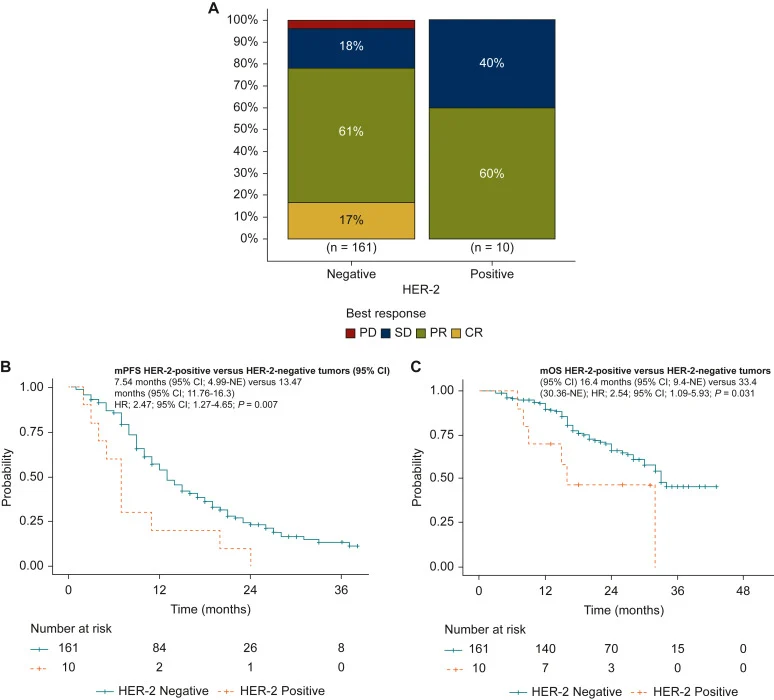
Descriptive subgroup observations showed that HER-2 mutations were associated with limited durability of response, with 6 of 7 patients showing PFS <8 months with FOLFIRI + cetuximab. In contrast, outcomes were more heterogeneous in tumors with ERBB2 amplification without co-mutations, with PFS exceeding 10 months in 2 of 3 cases. The researchers also noted that detection of ERBB2 amplification by liquid biopsy may be limited in samples with low ctDNA tumor fractions, supporting the value of paired tissue assessment when feasible.
conclusion
In this CAPRI-2 GOIM exploratory analysis, ERBB2 (HER-2) gene mutations were present in 5.8% of RAS/BRAFV600 WT MSS/pMMR mCRC and were associated with significantly worse outcomes characterized by shorter progression-free survival and overall survival with first-line FOLFIRI and cetuximab. These data support routine baseline assessment of HER-2 genomic alterations (amplifications and mutations) in patients being considered for anti-EGFR therapy to refine prognosis and identify patients who require alternative strategies, particularly in the presence of HER-2 mutations.
The full article can be found below ESMO Gastrointestinal Oncology.
read about CAVE-2 GOIM study results: ctDNA-guided cetuximab rechallenge in MSS RAS/BRAF wild-type metastatic colorectal cancer At OncoDaily.