
Japanese games were once at the center of the global game industry. Western and Chinese games have a large presence in today’s market, and recently the uniqueness of Japanese games such as Hideo Kojima’s “DEATH STRANDING” has been attracting worldwide attention. A look at the game industry in Japan and the world, which is at a turning point.
The game industry is maturing and becoming unstable at the same time.
In the 1980s and 1990s, Japanese games and other games had an overwhelming presence in the world market, but since the 2000s that momentum has become nostalgic. Although it has a domestic market of approximately 3 trillion yen, it can be said that it is at a disadvantage when it comes to overseas expansion.
Gaming is about to be an industry that is experiencing huge growth worldwide. According to research firm Newzoo, the global gaming market will reach $197 billion (31 trillion yen) in 2025. It is no longer a subculture, but is becoming a mainstream culture.
The background to this is that in recent years, restructuring and employment adjustments have begun, mainly at major Western companies. The reason for this is that the number of employees was expanded due to the need to stay at home during the coronavirus pandemic, the pace returned to normal after the coronavirus pandemic subsided, and structural reforms became inevitable. While there are titles that attract attention around the world, such as Grand Theft Auto VI, whose development cost is said to be 60 billion yen, there are also titles that end in service midway.
The world market is driven by the West and China
Approximately 50% of the global game market of 31 trillion yen is mobile games, 30% home games, and 20% PC games. Among these, Chinese companies such as Tencent and NetEase have a strong presence in mobile games. Armed with anime-like visual expressions and a development system that invests a lot of money and personnel, the company has been releasing titles with the premise of simultaneous global expansion, and “Genshin” (developed by miHoYo in Shanghai) is a good example of this. Western companies have a large presence in casual games, including the Candy Crush series.
When it comes to PC and live service type games (which continuously distribute content), Western companies are overwhelmingly dominant. E-sports titles such as “Legends” and “VALORANT” have formed a new gaming culture centered on continuous operation and competitiveness. Sandbox games such as Minecraft (in which users can freely play and adventure in a vast world) are also expanding the range of game creators, due to the spread of STEAM education (interdisciplinary learning that goes beyond the boundaries of humanities and science) in response to the age of AI.
One of the things that is making esports work in Japan is foreign titles. The programming school in question is exclusively for children.
Structural changes are also occurring in the home game console market.gamehas grown as a Japanese hardware, but following the release of the PS5, the development system was led by the United States, and it is difficult to say that it is a “domestic game console conceived and formed in Japan.” Domestic consoles, which were once Japan’s specialty, have virtually been unified by Nintendo.
The artistry of Hideo Kojima
Among the changes in both market structures, what is attracting attention is the uniqueness of Japanese games.Hideo KojimaThe same work that ended revolves around the story of a lonely courier in a devastated world, transporting goods to various places and developing relationships with people. Rather than fighting enemies, players spend more time experiencing the “travel experience” of transporting luggage across mountains and rivers.
In this way, while experiencing the game, Kojima proposed themes of “division” and “connection” that are deeply engraved in modern society. “DS2,” released in 2025, asks the question, “Is it a good thing for people to be too connected?” This series shows that the medium of games goes beyond silhouettes and becomes a cultural device that predicts the anxieties and hopes of the times.
Mobile games and live service games, which are the pillars of the global game market, don’t need impatient creators. However, from the perspective of cultural influence, works with strong ideology and individuality are significant.
The rise of innovative indie games
The rise of indie games made by small players and small capital is also important when talking about games originating in Japan. “Exit 8”, which has been made into a movie and will be distributed in North America, is a game with a very simple mechanism, where the player walks through the same underground passage over and over again, finding small “uncomfortities” lurking there. What it depicts is the disquiet that occurs when the world becomes slightly distorted, and it also empathizes with the Japanese fear culture seen in “Ring” and “Spiral.”
Perhaps the reason behind the phenomenon is the streamer(※1)Due to the spread of culture and social media, games have become not only “something to play” that is distributed, but also “something to be seen” and “something to be talked about.” Even though the work was produced by a small number of people, the power of the concept’s vivid sensibilities made it possible for it to transcend boundaries.
Contributing to the diversity of gaming culture
Let’s take a closer look at what are the characteristics of Japanese games. The first is character expression, which is strongly connected to manga and anime culture. Characters are recognized not as shorthand symbols or pawns, but as people and entities that progress the story. Players experience relationships with characters and share their emotions. Secondly, there is a craftsmanship that continually refines the perfection of the work. Rather than being a method for commercial success, these are creative attitudes that have been cultivated as a culture over many years.
In addition to the aforementioned Hideo Kojima, the names of creators such as Shigeru Miyamoto of “Super Mario”, Hidetaka Miyazaki of “Dark Souls”, and Masahiro Sakurai of “Super Smash Bros.” are mentioned along with the game title. Of course, not all Japanese games are based on authorism.
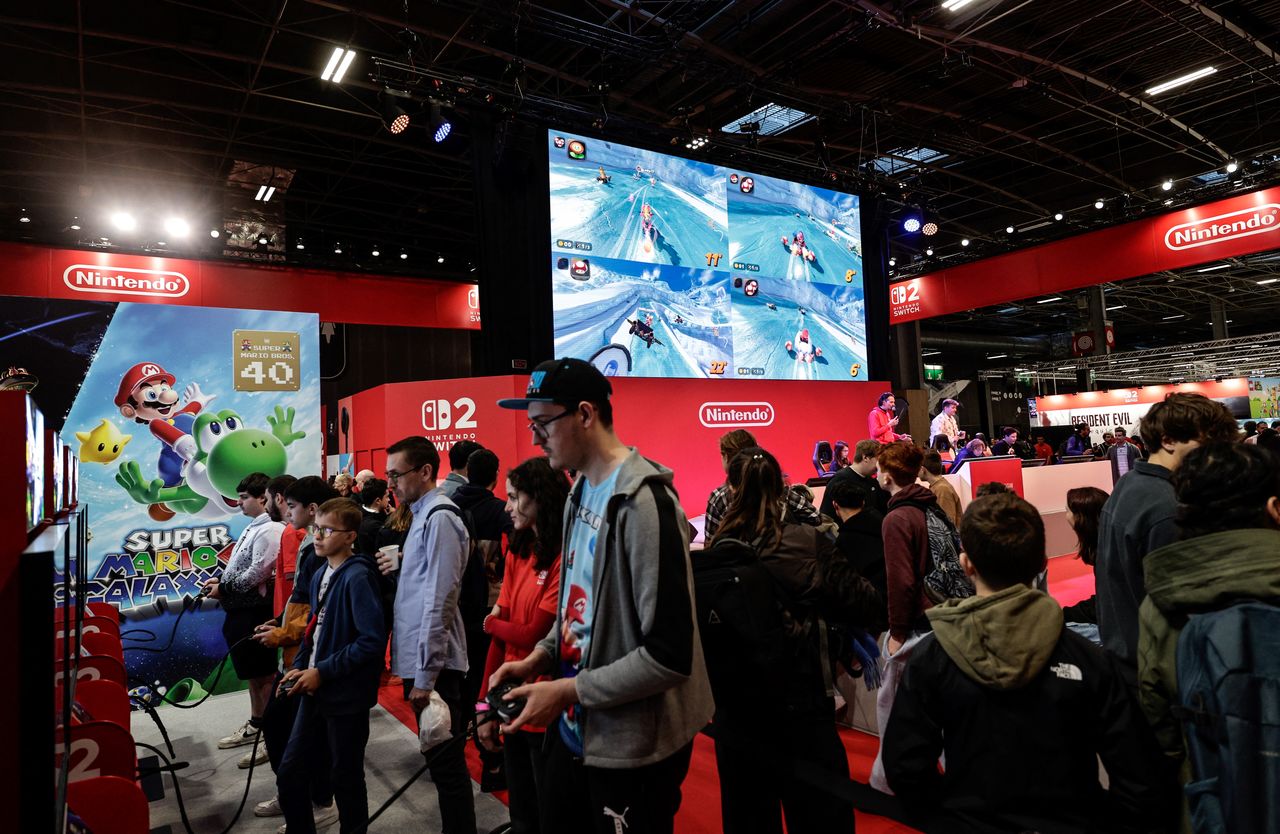
People playing Nintendo’s “Mario Kart” at France’s biggest game show “Paris Games Week” (October 2025/AFP = Jiji)
From the time when home video games became popular in the 1980s to the present, Nintendo has continued to create games with a focus on the experience of play. Rather than relying solely on the latest technology and performance competition, the attitude of emphasizing sensory aspects such as joy, surprise, and intuitive operation when touching a controller is one of the origins of Japanese gaming culture.
China and South Korea play a major role in online gaming culture and technology investment. Furthermore, recently, Saudi Arabia has been making huge investments using oil money, and is becoming the eye of a new typhoon in the game industry.
On the other hand, Japanese works are evaluated in areas such as storytelling, character expression, completeness, and authorship.
Game culture changed by the use of AI
Finally, we will look at the game industry after 2026. The structure that emphasizes blockbusters will definitely need to be reviewed, and management-based games(※2)Also, as the industry matures, new value propositions will be required.
Among these, Japanese games, even if they are inferior in market size, will continue to play a role in the diversity of international game culture as they present “games as culture.”
Banner photo: At “Tokyo Game Show 2025” held at Makuhari Messe. Capcom’s booth will introduce the SF action adventure “Pragmata” scheduled to be released in April 2026 (September 2025, Chiba Prefecture / AFP = Jiji)
(※1) ^ “Streamer” refers to an individual or group of people who stream videos over long periods of time on YouTube, etc. Mainly video game commentary and gameplay videos.
(※2) ^ “Management type game” and “live service type game” are almost synonymous. The former often refers to social games on smartphones, and the latter mainly refers to AAA games on home consoles and PCs.