
Stevens Institute of Technology physicist Igor Pikovsky and his colleagues are developing the first experiment designed to capture individual gravitons – particles previously thought to be essentially undetectable – heralding a new era in quantum gravity research.
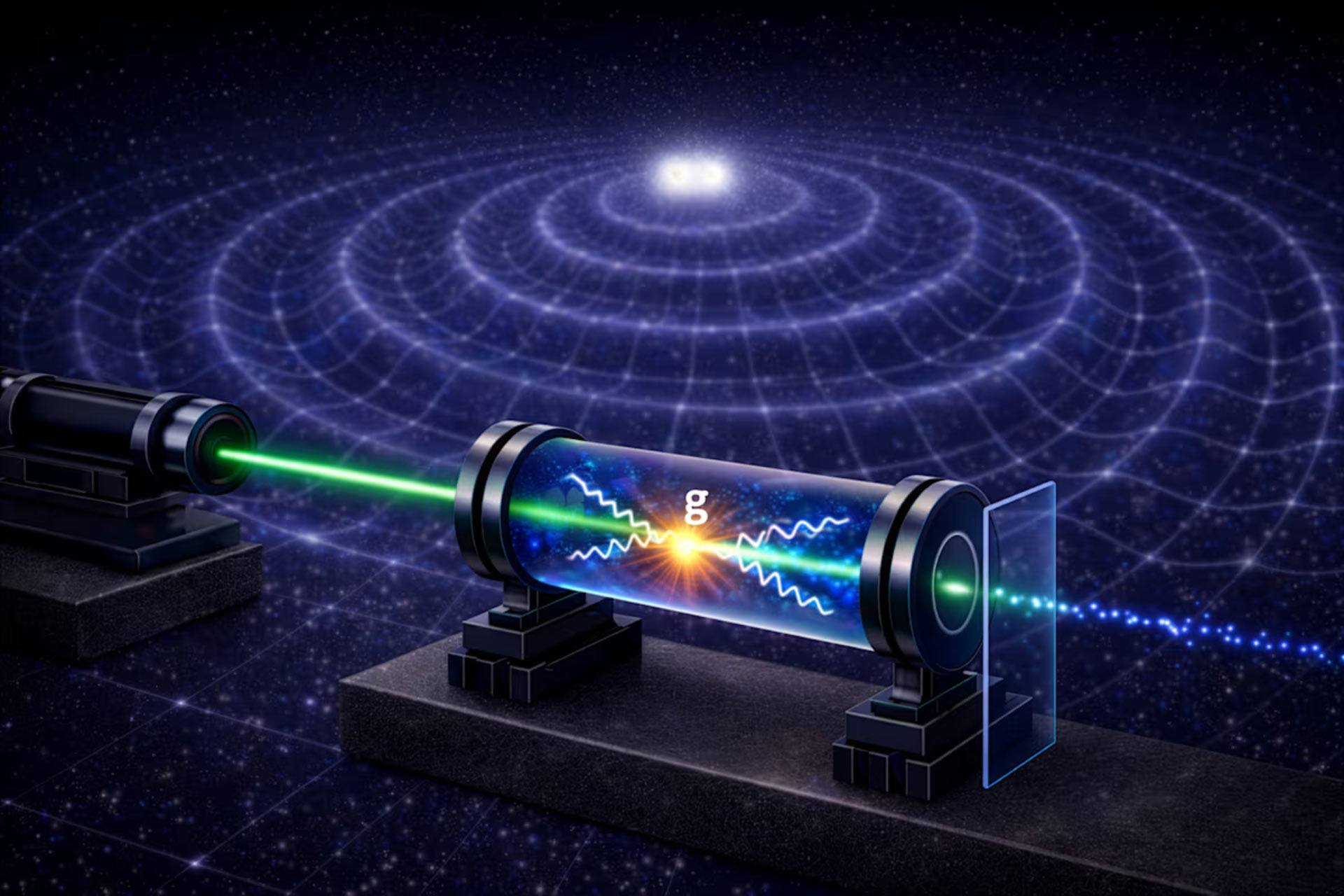
Single graviton signatures from gravitational waves may be detected in experiments in the near future. Image credit: I. Pikovski.
Modern physics has a problem. Its two main pillars are quantum theory and Einstein’s general theory of relativity, but these two frameworks seem contradictory at first glance.
Quantum theory explains nature in terms of discrete quantum particles and interactions, while general relativity treats gravity as a smooth curvature of space and time.
True unification requires that gravity itself be quantum and mediated by particles known as gravitons.
However, detecting even a single graviton was long thought to be essentially impossible.
As a result, the problem of quantum gravity remained largely theoretical, with no experimentally based theory of everything in sight.
2024 Dr. Pikovsky and colleagues at Stevens Institute of Technology, Stockholm University, Okinawa Institute of Science and Technology, and Nordita showed Detecting gravitons is indeed possible.
“For a long time, the detection of gravitons was thought to be hopeless, so it was never considered an experimental problem,” Pikovsky said.
“What we discovered is that this conclusion no longer holds true in the era of modern quantum technology.”
The key is a new perspective that integrates two major experimental advances.
The first is the detection of gravitational waves, which are ripples in space and time caused by collisions between black holes and neutron stars.
The second advance comes from quantum engineering. Over the past decade, physicists have learned how to cool, control, and measure increasingly large systems in real quantum states, yielding quantum phenomena far beyond the atomic scale.
In a groundbreaking experiment in 2022, a team led by Yale University professor Jack Harris demonstrated the control and measurement of individual vibrational quanta of superfluid helium weighing more than 1 nanogram.
Dr. Pikovsky and his co-authors realized that by combining these two features, it would be possible to absorb and detect a single graviton. A passing gravitational wave could, in principle, transfer exactly one quantum of energy (i.e., one graviton) into a sufficiently large quantum system.
The resulting energy shift is small but solvable. The real difficulty is that gravitons rarely interact with matter.
However, in quantum systems on the kilogram scale rather than the microscopic scale, it is possible to absorb a single graviton when exposed to strong gravitational waves from a black hole or neutron star merger.
Based on this recent discovery, Dr Pikovsky and Professor Harris are now working together to build the world’s first experiment explicitly designed to detect individual gravitons.
With support from the WM Keck Foundation, they are developing centimeter-scale superfluid helium resonators, approaching the regime needed to absorb single gravitons from astrophysical gravitational waves.
“We already have important tools; we can detect single quanta in macroscopic quantum systems; it’s just a matter of scaling,” Professor Harris said.
The goal of the experiment is to immerse a gram-scale cylindrical resonator in a superfluid helium container, cool the system to the quantum ground state, and use laser-based measurements to detect individual phonons (the vibrational quanta into which gravitons are transformed).
The detector builds on a system already in operation in the laboratory, but pushes it into new territory, scaling masses to the gram level while maintaining exquisite quantum sensitivity.
Demonstrating successful operation of this platform establishes a blueprint for the next iteration, which can be tailored to the sensitivity required for direct detection of gravitons, opening new experimental frontiers in quantum gravity.
“Quantum physics began with experiments with light and matter,” Pikovsky said.
“Our current goal is to bring gravity into this experimental realm and study gravitons the way physicists first studied photons more than a century ago.”