
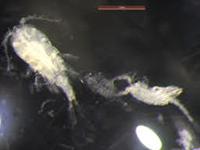
Among the organisms studied in the experimental tanks were small freshwater copepods (a type of zooplankton) that play an important role in regulating aquatic food webs.
Researchers observed that in tanks filled with fossil fuel plastic, the population of zooplankton (tiny aquatic animals that feed on algae and other species and serve as a food source for fish and other animals) immediately plummeted. Due to the lack of zooplankton herbivores, algal concentrations increased rapidly in these tanks. In contrast, aquariums tested with biologically based plastics were characterized by a much smaller impact on zooplankton and other members of the local ecosystem.
“Petroleum plastics appear to have a strong negative impact on zooplankton populations,” said Scott Morton, lead author of the study and a graduate student in biological sciences. “They either died quickly or their blooms seemed to decrease. Bioplastics didn’t have the same effect. It has a knock-on effect on the algae. In oil tanks, less zooplankton consuming all the algae means there’s more algae in the system, which leads to the algae blooms we saw.”
The researchers also recorded the emergence of distinct communities of bacteria that thrive in the presence of plastic, although the cause is still unclear.
“Our results show that microplastics can tip the balance of conditions in favor of algae development,” the authors conclude in their study. “These results collectively demonstrate that microplastics, particularly petroleum-based plastics, have the potential to destabilize the structure and function of microbial communities.”
Although the ecological impact of microplastics is only beginning to be studied, the authors note that a shift to a biodegradable plastics economy is likely to reduce the environmental impact of plastics in aquatic ecosystems.
For the past decade, co-author Professor Michael Burkhart and a group from the Department of Chemistry and Biochemistry have been working to develop and commercialize bio-based plastics specifically designed to biodegrade in the natural environment, which can be incorporated into consumer products such as surfboards, flip-flops, and mobile phone cases. “It’s important for us to understand how these new materials compare to traditional petroleum plastics when disposed of in the environment,” Burkhart said. “All man-made materials have an impact on the planet, and our goal is to minimize the ecological and health risks posed by these materials, which are now ubiquitous.”
Researchers are currently ‘living plastic” is filled with bacterial spores that break down the plastic material at the end of its life cycle.
The study’s authors are Scott G. Morton, Gabriel Vucelic-Frick, Jonathan R. Dickey, Bhausaheb S. Rajput, Cody J. Spiegel, Dahlia A. Loomis, Sara L. Jackrel, Michael D. Burkart, and Jonathan B. Shurin.
This research was supported by the Biological Sciences Pathways Training Program at the University of California, San Diego, through grants from the National Institute of General Medical Sciences (T32 GM133351) and the Department of Energy (DE-EE0009295).
Disclosure of Competing Interests: Mr. Burkart is a founder and holds an equity position in Algenesis Materials, which aims to commercialize renewable materials.